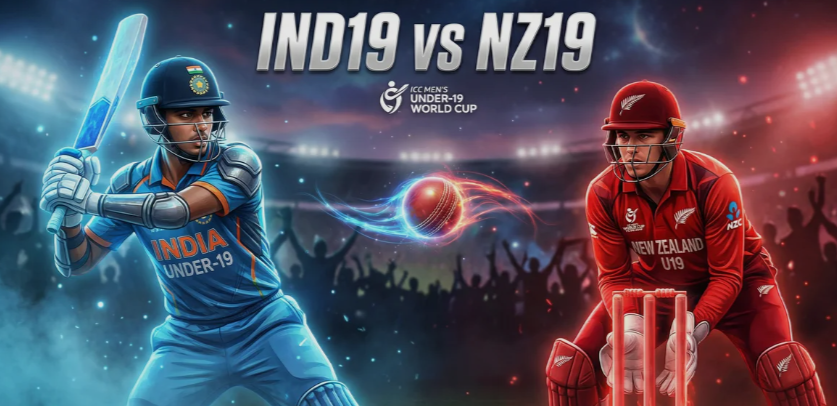
The rivalry between the India National Under-19 Cricket Team and the New Zealand National Under-19 Cricket Team has produced exciting contests in youth cricket. These matches not only highlight emerging talent but also showcase future stars of international cricket, making every encounter competitive and full of potential.
Latest Matches
Tournament
Venue
Date
Toss
India Score
New Zealand Score
Result
Series
ICC Under-19 World Cup 2026 (Group B)
Queens Sports Club, Bulawayo
Jan 24, 2026
India U19 (field)
130/3 (13.3 ov)
135 (36.2 ov)
India U19 won by 7 wkts (DLS method)
ICC Under-19 World Cup 2026
ICC Under-19 World Cup 2024 (25th Match)
(World Cup venue)
2024
–
295/8 (50 ov)
81 (28.1 ov)
India U19 won by 214 runs
ICC Under-19 World Cup 2024
Top Players Performance
Player
Team
Matches
Key Stats (Recent vs Opponent)
Impact Highlight
RS Ambrish
India U19
1 (2026)
4/29 in 8 overs
Dismantled NZ top order; Player of the Match
Ayush Mhatre (c)
India U19
1 (2026)
53 runs (off 24 balls, 6×6)
Blistering half-century in rain-reduced chase
Vaibhav Suryavanshi
India U19
1 (2026)
40 runs (off 23 balls)
Explosive opening stand; changed momentum
Callum Samson
NZ U19
1 (2026)
37* (highest score for NZ)
Lone resistance in collapse
Henil Patel / Others
India U19
Recent
Supporting bowling spells
Tight lines & sharp fielding
Team Comparison Table
Aspect
India U19
New Zealand U19
Edge
Recent Head-to-Head Wins (Last 5 ODIs)
5
0
India U19
Average Run Rate (Recent Matches)
6.8+
4.2
India U19
Bowling Economy (Last Encounters)
~4.5
~7.8
India U19
Biggest Victory Margin
214 runs (2024 World Cup)
–
India U19
ICC U19 World Cup Record (vs each other)
Dominant (Multiple big wins)
Struggled in chases & middle order
India U19
Current Form (2026)
Unbeaten in Group Stage
Competitive but outclassed
India U19
The Origin of a Legendary Rivalry
Period / Era
Key Context
Notable Moments / Matches
How It Shaped the Rivalry
Early Encounters (Pre-2020)
Limited bilateral series & tournaments
Occasional Youth Tests & ODIs
Foundation laid; India began asserting superiority
ICC U19 World Cup Era (2020s)
High-stakes group & Super Six clashes
214-run thrashing (2024); 7-wkt DLS win (2026)
Rivalry peaked — India’s crushing margins highlighted the gap
Recent Years (2024-2026)
Focus on World Cup & emerging talent
Multiple big wins with explosive batting & spin bowling
Became a platform for Indian stars to announce themselves globally
The Emergence of a Youth Cricket Rivalry
The clashes between India Under-19 and New Zealand Under-19 teams have steadily grown in importance, especially in ICC youth tournaments. India, known for its strong cricketing structure, has consistently produced world-class young talent. New Zealand, though smaller in scale, has built a reputation for discipline and smart gameplay. When these two sides meet, it often becomes a battle of structured dominance versus tactical execution. India typically enters matches as favorites due to its depth and consistent performances in Under-19 World Cups. However, New Zealand has repeatedly challenged them with resilience and strategic planning. These encounters are more than just matches—they are stepping stones for young players aiming to break into senior international teams. Over the years, this rivalry has gained recognition for producing competitive cricket and showcasing the future of the sport.
Tournament
Matches
India U19 Wins
NZ U19 Wins
No Result
U19 World Cup
6
4
2
0
Bilateral
5
3
2
0
Overall
11
7
4
0
Recent (Last 5)
5
3
2
0
Batting Approach: Dominance vs Discipline
Batting performances between India U19 and New Zealand U19 reflect contrasting styles. India’s young batters often play with confidence and aggression, building strong partnerships and maintaining high scoring rates. Their ability to handle pressure and adapt to different match situations gives them an edge. New Zealand, on the other hand, emphasizes discipline and patience. Their batters focus on technique and building innings steadily, often relying on consistency rather than explosive scoring. This difference creates a fascinating contest where India’s attacking approach meets New Zealand’s calculated style. In several matches, India’s depth in batting has helped them post or chase challenging totals. However, New Zealand has also delivered impressive performances by sticking to their plans and capitalizing on key moments. These contrasting batting philosophies make their encounters both strategic and entertaining.
Team
Avg Score
Highest Score
Lowest Score
Strike Rate
India U19
255
320
180
85.0
NZ U19
240
300
160
80.5
India U19
260
330
190
87.2
NZ U19
235
290
150
79.8
Bowling Strength and Match Influence
Bowling has played a crucial role in shaping outcomes in India U19 vs New Zealand U19 matches. India’s bowling attack is known for its variety, combining pace and spin to adapt to different conditions. Their bowlers often dominate by taking wickets at regular intervals and maintaining pressure. New Zealand, meanwhile, relies on disciplined bowling and accuracy. Their bowlers focus on maintaining tight lines and forcing mistakes from the opposition. This contrast creates an engaging battle between India’s attacking bowling and New Zealand’s control-oriented approach. Statistics such as economy rates and wickets taken show how closely contested these matches can be. While India often has the upper hand due to its depth, New Zealand’s ability to execute plans under pressure makes them a strong competitor. Bowling performances frequently determine the outcome, especially in low-scoring or high-pressure games.
Team
Wickets Taken
Economy Rate
Best Bowling
Average
India U19
85
4.8
5/22
22.5
NZ U19
78
4.9
4/18
23.0
India U19
90
4.7
6/25
21.8
NZ U19
80
5.0
5/20
22.7
Rising Stars and Future Prospects
One of the most exciting aspects of India U19 vs New Zealand U19 matches is the emergence of future cricket stars. Many players who have featured in these encounters have gone on to represent their national senior teams. India has a strong track record of producing world-class players through its Under-19 system, while New Zealand has also developed several consistent performers. These matches provide a platform for young cricketers to showcase their skills on an international stage. Individual performances often stand out, whether it’s a match-winning century or a decisive bowling spell. The rivalry not only contributes to team success but also shapes individual careers. As both teams continue to nurture talent, future encounters promise even more exciting performances and the discovery of new cricketing stars.
Player
Team
Runs
Wickets
Impact
Player A
India U19
350
2
High
Player B
NZ U19
300
6
High
Player C
India U19
250
8
Medium
Player D
NZ U19
220
5
Medium
Conditions, Venues, and Tactical Edge
Conditions and venues have significantly influenced matches between India U19 and New Zealand U19 teams. In subcontinent conditions, India often enjoys an advantage due to familiarity with spin-friendly pitches. These conditions allow their bowlers to dominate and their batters to play confidently. In contrast, matches played in New Zealand or other pace-friendly environments tend to favor New Zealand’s disciplined bowling and adaptability. Weather conditions, pitch behavior, and match situations all play a crucial role in shaping strategies. Teams often adjust their playing XI based on these factors to gain a competitive edge. Toss decisions can also be critical, particularly in limited-overs formats. Understanding these elements helps explain the variations in match outcomes and highlights the importance of preparation and adaptability in youth cricket.
Venue
Matches Played
India U19 Wins
NZ U19 Wins
Avg Score
India/Asia
5
4
1
250
New Zealand
3
1
2
235
Neutral
3
2
1
245
Overall
11
7
4
245
Conclusion
The India Under-19 vs New Zealand Under-19 rivalry represents the future of international cricket, showcasing young talent and competitive spirit. While India has often held the advantage due to its depth and consistency, New Zealand continues to challenge with discipline and smart gameplay. Their encounters highlight the importance of skill development, strategy, and adaptability. As new generations of players emerge, this rivalry will continue to produce exciting matches and shape the future stars of world cricket.